Why Motion Alerts Get Turned Off Within a Week
Every store owner who installs cameras goes through the same week. The app is new, the notifications are exciting, and the phone buzzes when a car pulls into the lot. By Wednesday it buzzes when a moth lands on the lens. By Friday the notifications are off, and the cameras go back to being what they were before: a box that records footage nobody watches.
This is not a failure of willpower, and it is not particular to cameras. It is what happens to any alarm that is wrong most of the time.
The numbers on alarms that cry wolf
Burglar alarms are the oldest version of this problem and the best documented. The US Department of Justice's guide on false burglar alarms puts it plainly: between 94 and 98 percent of alarm calls are false, and in some places the rate is worse. Dallas logged about 62,000 alarm calls in 2004, of which 2.8 percent turned out to be real. Commercial alarms are up to three times more likely to be false than residential ones, which is to say that the version aimed at businesses is the version that works least well.
Hospitals learned the same lesson from the other direction. A review in AACN Advanced Critical Care found that 72 to 99 percent of clinical alarms are false. In one study of 461 intensive-care patients, 31 days of monitoring produced more than 2.5 million alarms - about 187 audible warnings per bed per day. The result is not vigilance. The US Agency for Healthcare Research and Quality describes the outcome as clinicians who ignore "both the bothersome, clinically meaningless alarms and the critical alerts" that warn of real harm. People do not become better at filtering noise. They stop listening to the channel.
Your phone is already contributing. A study that instrumented real phones for a week found people receiving about 64 notifications a day, and more notifications correlated with feeling stressed and overwhelmed. A camera that adds thirty more is not adding information to your day. It is competing with your family's text messages, and it will lose.
Why motion is the wrong trigger
A motion detector answers one question: did some pixels change? A cat, a headlight through the window, a plastic bag, the store's own sign flashing, rain on the lens, a shadow at four in the afternoon when the sun comes down the street. All of them are motion. None of them is an event.
The camera industry knows. A patent granted to a camera-chip maker describes the problem in its own words: one "annoying user experience that provides no value for the consumer" is when the owner's own movement constantly triggers motion notifications, and the usual workaround, snoozing the alerts, either keeps annoying you or leaves the place unwatched. Ring's own community forum has years of threads from customers asking for a way to cap how often the doorbell can alert them, with one describing notifications that "keep coming over and over and over again".
The industry's fallback is that somebody will watch the monitors instead. Almost nobody does. A survey of more than 120 security integrators concluded that less than one percent of all cameras are ever really monitored live, and where live monitoring exists in retail it usually covers business hours only. So a store ends up with two failed channels at once: alerts nobody reads, and footage nobody watches.
What actually fixes it
Police departments did not solve false alarms by buying better motion sensors. They solved it by adding a verification step before the alarm was allowed to consume anyone's attention. Requiring the alarm company to make two calls before requesting a dispatch - "enhanced call verification" - cut false alarm calls by 25 to 40 percent. Requiring actual visual confirmation before a dispatch, the policy known as verified response, cut alarm calls by roughly 90 percent. The sensors did not change. What changed was that something looked before the siren reached a human being.
That is the design principle worth stealing. The question is not "how sensitive should the camera be?" It is "what checks this before it reaches the owner's phone?"
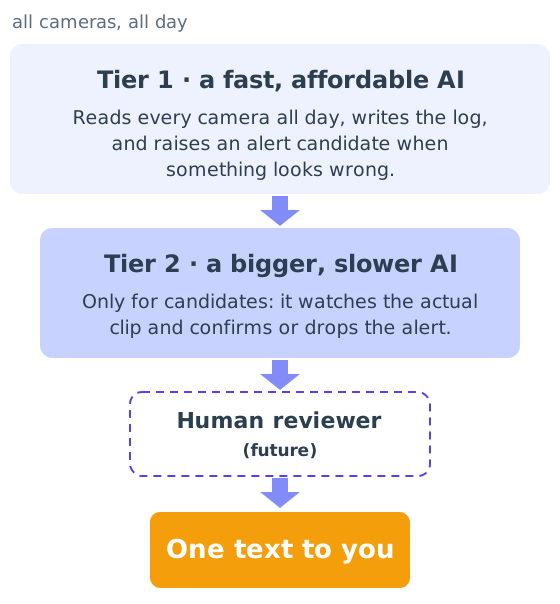
In our system, two AIs do that job. The first watches every camera continuously and writes down, in plain English, what is happening. When something looks serious, or matches an instruction the owner wrote, a second AI pulls the actual video clip and confirms it before anything is sent. If it cannot confirm what it saw, no message goes out. The owner gets a text with a short clip and a sentence saying what happened and why it mattered.
Both stages are AI, and AI can be wrong; we would rather say that than pretend otherwise. But the error that matters here is asymmetric. A missed event costs you one event. A false alert costs you the channel - and once the channel is off, every future event is missed too. So precision comes first, deliberately, even though it means occasionally staying quiet when we are unsure.
When both stages make the same mistake, a false alert still gets through. The fix the police settled on points to the next step: a person looks at the clip before the text goes out. We have not built that tier yet. We will when customers ask for it.
Shobdo VideoRAG is an AI agent for the security cameras your store already owns. It writes down what it sees and texts you when something matters. You can also ask it to send alerts on specific events that you describe in plain English. Learn more or book a conversation.