Why Shobdo VideoRAG Never Stores Your Video?
The video surveillance AI market is projected to reach $49 billion by 2035, growing at over 20% annually. Nearly every video surveillance AI product works the same way: cameras record, footage goes to someone else's cloud, and their AI processes it there. The video sits on their servers — sometimes indefinitely.
We built Shobdo VideoRAG differently. Client video is never stored on our servers. That is not a privacy toggle buried in settings. It is how the system is designed from the ground up.
The problem with storing video in the cloud
A single 1080p camera running 24/7 with H.265 compression generates roughly 30 to 50 GB per day — call it 1 TB per month. A small store with eight cameras produces 4 to 8 TB monthly. At AWS S3 Standard rates of $0.023 per GB, storing 8 TB costs about $184 per month — just for storage. Add egress fees for actually retrieving that footage ($0.09 per GB for the first 10 TB), and reviewing even a fraction of it gets expensive fast. Multiply by months of retention, and the bill becomes the dominant cost of the entire system.
Then there is the question of who else has access to that footage.
In 2021, hackers breached Verkada and accessed 150,000 live camera feeds from hospitals, schools, police departments, and corporate offices — using a single exposed credential. The FTC later required Verkada to pay a $2.95 million penalty. Separately, the FTC charged Ring with failing to restrict employees' and contractors' access to customer video — one employee viewed thousands of recordings from customers' bedrooms and bathrooms — and with using customer videos to train algorithms without consent. Over 55,000 customers experienced account compromises. The $5.8 million settlement followed.
These are the predictable consequence of a design where the video leaves the customer's control.
What Shobdo VideoRAG does instead?
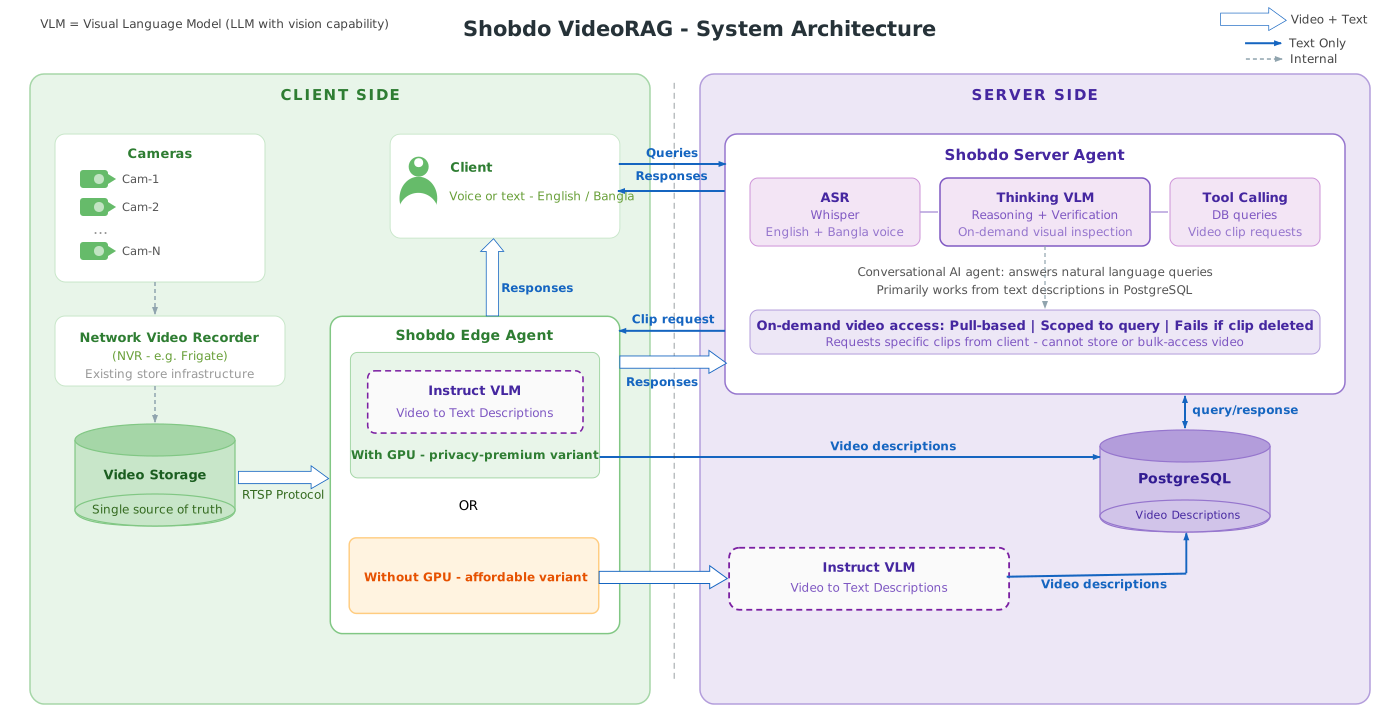
Shobdo's AI watches camera footage and converts it into structured text descriptions — human-readable event logs that record who appeared, what they did, and when. Only those text descriptions are stored on our servers. The raw video stays on the client's local storage.
Industry estimates suggest that less than 1% of surveillance footage is ever actively monitored or reviewed. A human operator's ability to detect incidents drops by 95% after just 20 minutes of watching monitors. The vast majority of recorded video exists solely as insurance — hours of empty aisles and quiet hallways, retained in case something needs to be checked later.
Shobdo replaces that model. Instead of storing everything and searching later, our AI processes footage as it happens and produces searchable text. A store owner asks "Who was in the whiskey aisle between 2 and 4 pm?" — the system searches text, not video, and returns references to the exact clips on local storage in under a second.
When the AI does need to look at a specific video clip — say, the text log mentions someone lingering near the register but the store owner wants to see what they were holding — it requests that clip from the client's local storage on demand. If the clip has been deleted or overwritten, the request simply fails. There is no independent copy. The client's video storage is the single source of truth.
Two deployment options, one guarantee
Not every store owner can afford a GPU. Requiring one would price out exactly the businesses we built this for.
So the VideoRAG solution from Shobdo offers two deployment paths:
With a GPU on-site deployment, the video to text runs locally on the client's hardware and only the resulting text descriptions are sent to our server. This is the privacy-premium option: video data never crosses the network.
In without a GPU deployment, video is sent to our server where the same AI processes it into text. The video is processed in memory and discarded. Only the text descriptions are stored in the database. This is the affordable option: same AI capability without the hardware investment.
In both cases, video is never stored on our servers. The guarantee is the same regardless of which path the client chooses.
Why this makes Shobdo VideoRAG cheaper?
The privacy design has a direct economic consequence.
The cloud storage costs described above — hundreds of dollars per month per store, before retrieval or retention — would be the single largest line item in the system. By storing only text descriptions, we eliminate it almost entirely. An event log entry is roughly 0.1 to 2 KB. A month of activity from eight cameras might produce a few hundred megabytes of text. The cost difference is several orders of magnitude.
That saving is what makes Shobdo's pricing work for a store with four cameras and tight margins.
Shobdo VideoRAG is an AI agent for surveillance cameras. Ask questions in plain English or Bangla and get the exact clips in seconds. Learn more or book a conversation.