Gas Station Security Cameras: Pumps, Store and Lot at Night
The short version
Point gas station security cameras at the front of every pump, the register, the doors, the ATM and the lot, and keep the pump area lit at night. Cameras rarely stop drive-offs, because they rarely get a readable plate; prepay does that. What a pump camera can catch is someone opening the pump cabinet, which is how skimmers and pump tampering get in.
- Aim a camera at the front of each pump island so it sees the card reader and the cabinet door, and leave the pump lights on at night.
- Prepay or pay at the pump is the fix for drive-offs; a 2012 police guide found that cameras miss many plates.
- In 2025 the Secret Service and local police inspected nearly 60,000 terminals, gas pumps and ATMs and removed 411 skimming devices.
- Skimmers and pump tampering both start with someone opening the cabinet, and that moment is worth a text.
- Shobdo texts you when a moment you named, like someone opening a pump, has been checked on video by a second AI.
In this post
A gas station is two businesses on one lot. Inside is a convenience store, with a register, a cooler and a back door. Outside are the pumps, often open all night, where many people pay at the pump and meet no one. So where should gas station security cameras point? At both. Put a camera on each pump island that sees the card reader and the cabinet door. Then cover the register, the front door, the back door, the ATM and the lot.
The harder question is what the cameras are for. A pump camera rarely stops a drive-off, because it rarely gets a readable plate. That job belongs to the way customers pay. What a pump camera can catch is the person who opens a pump cabinet at 2 a.m. That is how skimmers get in, and a newer kind of fuel theft too. Below: where each camera goes, what the law asks, and which moments at night are worth a text.
Why is a gas station harder to watch than a store?
Because nobody inside can see all of it. There are 122,620 convenience stores that sell fuel in the United States, and together they sell an estimated 80% of the fuel consumers buy. In the same count, 63% of convenience stores belong to a company with 10 stores or fewer.
Now look at the lot from the register. The clerk sees the pumps through the front window, past whatever is taped to the glass. The police guide on gas drive-offs from Arizona State University's Center for Problem-Oriented Policing is about exactly this view. It dates from 2012, and it is the newest police guide on the subject we found. It wants the pump island directly in front of the store, no posters on the windows, and shrubs under 3 feet. It also suggests coning off the pumps furthest from the clerk after dark. Every one of those helps one person see more of the lot.
Then the store closes, or the clerk is busy with a line. The pumps keep selling. At that hour a camera is often the only thing looking at them.
Where should gas station security cameras point?
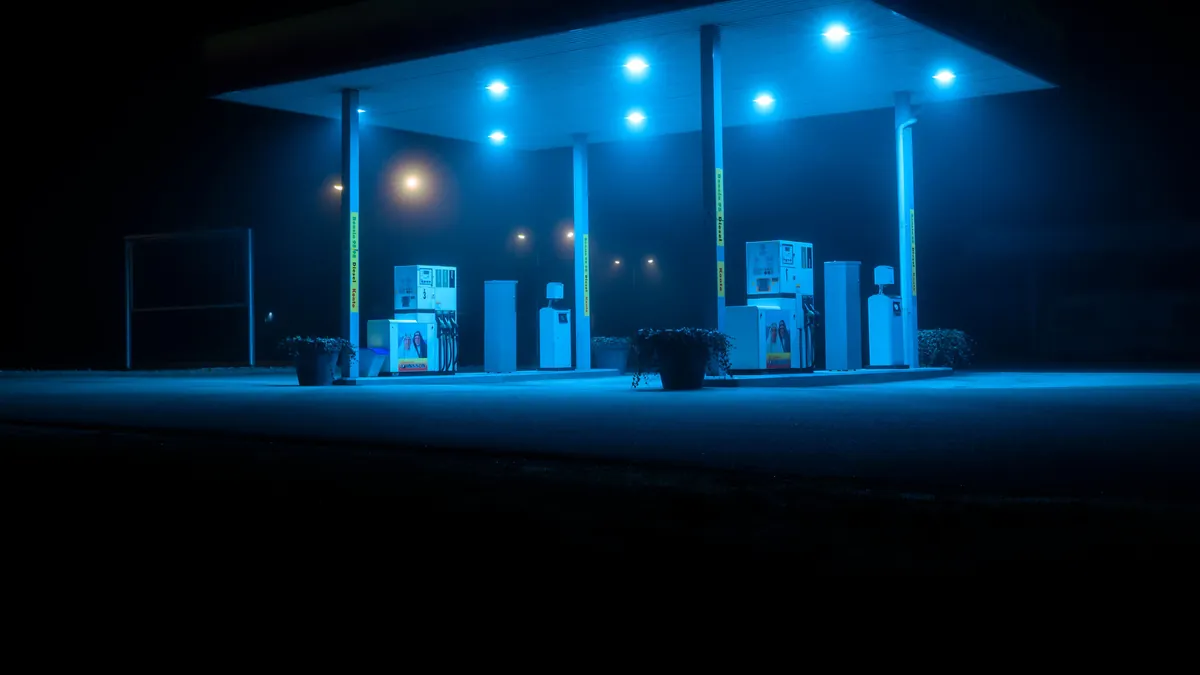
Start at the pumps. In 2018 Madison, Wisconsin, made convenience stores put cameras on entrances, exits, registers and all pumps, placed to catch each customer's face. A store without them can be fined $100 a day. The police guide adds two things for pump cameras. Light the pump area, and leave the lights on at night so the cameras can see. A camera over a dark island records shapes.
Aim each pump camera at the front of the dispensers. That way it sees the card reader and the cabinet door, which is where both pump crimes below begin. Add one wide camera over the forecourt to see which way cars leave.
Inside, the store needs the same cameras as any convenience store, and we went through those in convenience store security cameras. A gas station adds two places.
The first is the ATM. Why the ATM? Because free-standing ATMs in convenience stores and gas stations are the prime targets for card skimming, by FICO's count. In 2025, 90% of the ATM compromises FICO tracked happened at machines that do not belong to a bank, and many were hit more than once. FICO's advice is to inspect those machines for tampering often and to put video on them. Loomis, the cash-handling company, puts a camera on the ATM next to the ones on the registers and the safe.
The second is the lot: the car parked away from the pumps, the trash enclosure and the back of the building.
Can cameras stop gas drive-offs?
Not by themselves. Drive-offs did fall. The police guide puts their cost at convenience stores at $300 million in 2005 and $89 million in 2009. It credits two things for the drop: better video, and paying first. Yet the pictures are often too poor for the police to use. Thieves park behind a truck, stand in front of the plate, or put stolen plates on the car. Even with a camera on every fueling point, it would be hard to catch every plate.
So what works? Payment. The guide calls prepay the simplest way to stop drive-offs, and pay at the pump probably the most effective. Prepay has a cost too, because a customer who paid inside first is less likely to come back in for a drink. That is why many stations ask for prepay only at certain pumps or at certain hours. A station can look at where and when its own drive-offs happen, and set the rule there.
Where does that leave the camera? It records the car, the time and the direction it left, for the police report. Shobdo does not read plates today; for a vehicle it describes the car and what it did. If drive-offs are the main problem, a prepay rule or a camera built to read plates is the tool for that job. The recorder keeps the clip either way.
How do skimmers and fuel thieves get into a pump?
Through the cabinet door. A skimmer is a hidden card reader that copies cards. On a pump it usually sits inside the cabinet. In 2025 the Secret Service and local police inspected nearly 60,000 point-of-sale terminals, gas pumps and ATMs in 22 operations and removed 411 skimming devices. The agency puts the losses those operations prevented at more than $428.1 million.
What happens after a skimmer is in? A Texas case from June 2026 shows it. Investigators found that a ring had put skimmers on diesel pumps and used the stolen card numbers to get fuel from truck stops across North Texas. They took 1,500 to 2,500 gallons a night, five or six nights a week, into tanks hidden inside their own vehicles.
There is a second way into the same cabinet. In 2024 NACS, the convenience store trade association, passed on a Texas alert about thieves who get inside the pump cabinet and power the valve with batteries, so the fuel flows for free. The same alert warned that most door security would not stop it.
In other words, both crimes start the same way: someone opens the front of a pump. Florida's law is built around that moment. Since January 1, 2022, every retail fuel pump with a card reader there needs at least two of eight security measures. Among them are security tape over the panel, a lock with a key unique to the station, an alarm that alerts the owner when the panel is opened without permission, and a daily inspection that opens the panels.
A camera does not replace any of these. What it adds is the clip of who opened the panel, and when. And if you find a skimmer? The Secret Service tells businesses to take the terminal out of service and call the local police, who retrieve the device and handle it as evidence. So leave it in place for them.
Which moments at a gas station are worth a text?
A few, and none of them is plain motion. Pump cameras see cars all night. Headlights sweep the lot, fog drifts under the canopy lights, and a truck idles at the diesel island. So a motion alert there would probably fire with every car, and alerts like that get turned off within a week.
So name the moment instead. Someone opening the front of a pump. Someone working on the front of the ATM. A person behind the counter after close. A car backed up to the back door at night.
That is what a watch instruction does in Shobdo. You write it in your own words, for one camera or the whole station: "Tell me if anyone opens the front of a pump." The first AI writes down what every camera sees, around the clock. When something matches an instruction, a second AI pulls the clip and watches it before anyone is texted. If it cannot confirm the event on video, nobody gets a message.
It works with the recorder the station already owns: Dahua, Hikvision, Frigate NVR, and anything supporting ONVIF or RTSP protocols. Footage stays on the recorder, and video is not stored in the cloud. The only video that travels is the short clip in the alert, and it expires within 24 hours. No audio is captured. The price is published: $179 a month to watch 8 cameras, $312 a month to watch 16, and smaller plans from $39 a month to watch one camera. The first 7 days are free.
Now the limits. Shobdo does not call the police for you today; you see the clip and decide. Each alert already arrives as a checked clip with a written description, so handing it on to a monitoring center the owner picks fits the same design. A monitoring company does that job today, and we compared the options in remote video monitoring costs. Shobdo also does not recognize faces, on purpose. It describes what happened, not who did it.
What helps most against each problem?
Here are the four problems side by side, with what the sources above found against each one and what a camera adds.
| Problem | What the sources found | What the camera adds |
|---|---|---|
| Drive-offs | Prepay, or pay at the pump | The car, the time and the way it left |
| Skimmers in a pump | Two or more pump security measures and a daily check | Who opened the cabinet, and when |
| Fuel theft through the cabinet | Most door security does not stop it | The same clip, and a text at night |
| ATM skimming | Regular checks of the ATM for tampering | Who worked on its front |
Prepay takes care of the first row. In the other three, the camera sees the act itself, and not only a car leaving.
Common questions
Are gas station security cameras required by law? In some places. Florida's convenience business law covers a store that sells groceries, or groceries and gasoline, stays open at some point between 11 p.m. and 5 a.m., and holds a state alcohol or tobacco license. Such a store needs a camera system that can record and retrieve an image to help identify an offender. Madison asks for cameras on every pump. Elsewhere, ask your city and your state.
How long do gas stations keep camera footage? As long as the recorder's drive holds it. Loomis recommends being able to pull at least 30 days. A police request or a dispute about a pump can arrive later than that, so export the clip the day you hear about it. Who asks, and when, is in who actually asks for your footage.
Can I get a text instead of watching the pump cameras all night? Yes. Name the few moments you care about, in plain words, and have each alert checked on video first.
Shobdo is an AI agent for the security cameras your store already owns. It writes down what it sees and texts you only when something matters. Learn more or book a conversation.