Remote Video Monitoring: What It Costs and Who Watches
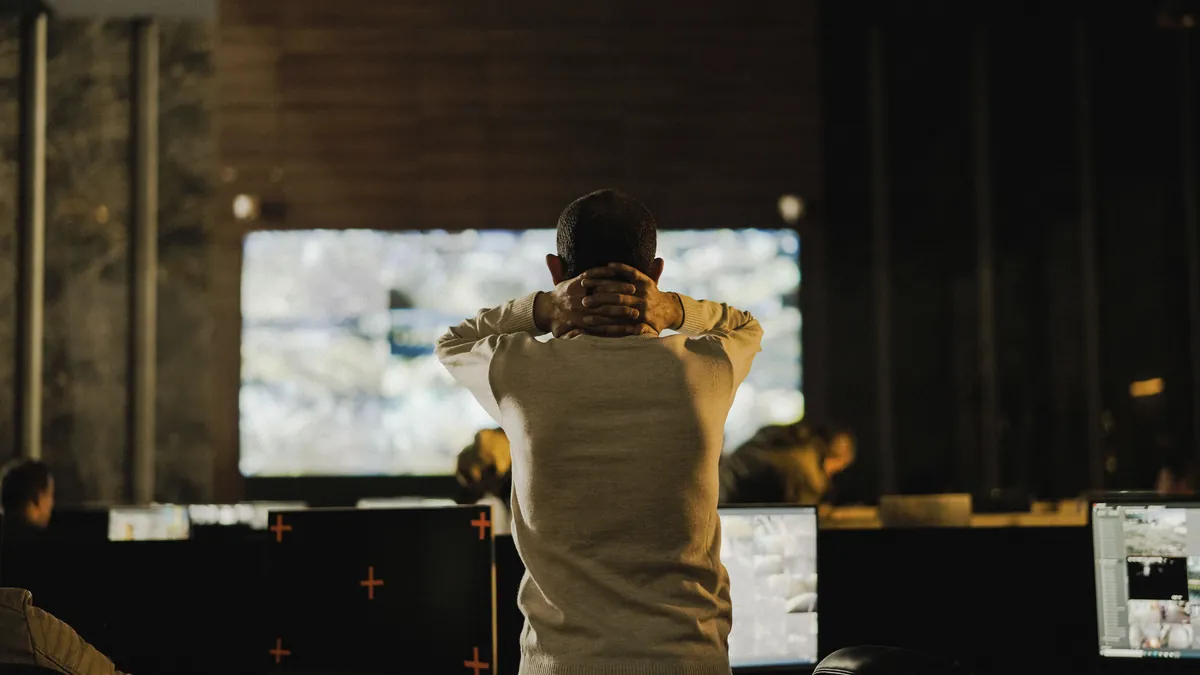
It is 2 a.m., and someone is standing at the back door of your store. Who sees it? That is the real question behind remote video monitoring. You pay someone, or something, to look at your cameras while you sleep.
So what does remote video monitoring cost, and what do you get for the money? A monitoring company, where people look at your cameras, costs a few hundred dollars a month for a small store by the vendors' own figures. A guard on site every night costs several thousand. Alerts from an AI to your own phone are a monthly subscription, and you are the one who decides what happens next. Each of the three does something different at 2 a.m. Below we go through them, with published numbers. We sell one of them, so our limits are in here too.
What is remote video monitoring?
Remote video monitoring means a trained operator watches your cameras from another place, down the road or across the country. But does that operator stare at your cameras all night? No. Most of the night, nothing happens on most cameras. We wrote about that in most of the world is uneventful. So a machine looks first. At Deep Sentinel, motion-activated cameras stream to an AI hub at the site, and a guard watches whenever a person steps onto the property. SimpliSafe's agents see video only during an alarm, or when its AI spots unusual activity outdoors. Then the person acts. They can talk through the camera's speaker, sound a siren, turn on a light, or call the police. In other words, every option in this post starts the same way: a detector picks the moments worth a look. What changes is who looks second, and what that person can do from there.
How much does remote video monitoring cost?
Most monitoring companies do not publish a price. You call, they look at your site, and you get a quote. So the best numbers we have are the companies' own estimates.
Pro-Vigil puts a small business with 4 to 8 cameras at $200 to $800 a month for monitoring. A business with 8 to 20 cameras is $800 to $2,000. Cameras and installation come on top, as a one-time cost. Deep Sentinel's own comparison puts its business service at $300 to $500 a month on average.
Why such a wide range? Because the quote is built from a few choices. How many cameras? Which hours: overnight only, after hours, around the clock, or only when an alarm goes off? And what is the operator expected to do: send you a note, talk to the person, or call the police? Pro-Vigil walks through these in its guide to virtual guard pricing. More hours and more cameras mean a bigger bill.
The rare published price is for homes. SimpliSafe charges $1.66 a day for live agents overnight, from 8 p.m. to 6 a.m., and $2.66 a day around the clock. That is about $50 and $81 a month. The agents work through SimpliSafe's own outdoor camera and doorbell. Its business page offers the same live agents to businesses, but shows no plan price. Why is the home plan so much lower? Probably because it covers a few of SimpliSafe's own cameras, and the agents look only when the system is armed and its AI flags someone. When a quote comes, ask for it in pieces: the price per camera, the hours, what the operator does, the hardware, and the contract length.
What does a security guard cost for the night shift?
A guard does what no camera does. A guard walks the lot, tries the doors, and is there when something happens. That is also why a guard costs the most.
The median wage for security guards was $38,020 a year in May 2025, about $18 an hour. Now take one night shift, 10 p.m. to 6 a.m., every night of the year. That is 2,920 hours, or about $4,400 a month in wages alone. Payroll taxes, cover for sick days and an agency's margin come on top. Deep Sentinel's comparison puts an on-site guard at $6,000 to $8,000 a month, which fits that math.
So a guard probably makes sense where the value sits outside and needs someone walking it, like a car lot or a building site. For a corner store with one back door, that is a large bill for one person on one shift.
What happens when the monitoring company calls the police?
This is the part a quote does not show. Police departments have learned that most alarms are false. The Los Angeles Police Department puts it plainly: "the vast majority of alarm calls are false." As a result, the city charges for them. In Los Angeles, an alarm user with a permit pays $260 for the first false alarm, $310 for the second and $360 for the third. That fee took effect on May 4, 2026.
Then there is a second rule. After two false alarms in 365 days, LAPD puts the address on "broadcast and file" status. Now the police want proof of an actual break-in. Without it, the call goes out to any free unit. If no unit is free, it is filed with no police response.
In other words, a call backed by video carries more weight than a bare alarm. That is a real part of what monitoring companies sell: an operator looks at the clip first and then calls. SimpliSafe offers video verification for this reason. Its agents pass what they see to dispatch, for a faster response than an unverified alarm gets. The same thing happens to the alerts on an owner's phone, as we wrote in why motion alerts get turned off within a week. When most of them are wrong, people stop acting on them.
What do AI alerts to your own phone do at 2 a.m.?
The third option has no operator. The AI does the first and the second look, and you decide what happens next. Shobdo VideoRAG works this way, and it is the one we sell.
A small Linux computer at the store connects to the recorder you already have: Dahua, Amcrest, Hikvision, or anything with ONVIF or RTSP. The first AI writes down what happens on every camera, in plain English. You write watch instructions in your own words, such as "tell me if anyone goes behind the counter after 9". When something matches, a second AI pulls the clip and watches it before anyone is texted. If it cannot confirm the event on video, nobody gets a message. Then you get a text with a short GIF and a link, or a Telegram message. Footage stays on your recorder, and video is not stored in the cloud.
Why the second look? Because a phone that buzzes for every shadow gets muted, and then nobody is watching at all. Plain words matter for the same reason. You name the thing you actually worry about, as we explained in watch for the thing you actually worry about, and the rest stays quiet.
The price is published: $45 a month for 3 cameras, $125 for 8 and $200 for 16, with $25 a month for each extra camera. The first 7 days are free with a card. The box at the store, the Shobdo Edge Regular, is a one-time $199 plus shipping, or you use your own Linux computer.
Now, what VideoRAG does not do today. It does not call the police for you: you see the clip, and you decide. Each alert already arrives as a checked clip with a written description, so handing it on to a monitoring center the owner picks fits the same design. It also does not talk to anyone at the store or set off a siren, and it captures no audio. Some cameras already carry a siren and a speaker. Dahua's TiOC cameras, for example, have a warning light, 11 built-in sounds and room for a custom voice message. The second AI already confirms the event before anything happens, so setting off the store's own siren or recorded warning after that check fits the same design. And it needs the internet. While the connection is down, alerts pause, but the recorder keeps recording.
Which option fits your store?
Start with what you want to happen at 2 a.m. If nobody will answer a text at that hour, or you want someone to speak to the person at the door right away, a monitoring company fits. It does that job well, and Deep Sentinel, for one, sells it to car dealers, building sites and warehouses. If you want to know when the thing you named happens, and you want to make the call yourself, alerts to your phone fit. Some owners will want two of these: a monitoring company on the alarm panel, for example, and alerts on the cameras.
Most American businesses are small, and the owner is often the one who opens in the morning. We wrote about those owners in the corner store is the hardest customer in AI. For them, who acts at 2 a.m. matters as much as who watches. A monitoring company acts for you. Alerts give the decision back to you, with a checked clip to look at.
The same facts side by side, as of October 2026:
| Who looks | What happens next | Cost per month | |
|---|---|---|---|
| Monitoring company | An AI, then an operator | Talk-down, siren or a police call | $200 to $800 for 4 to 8 cameras (Pro-Vigil's estimate); $300 to $500 (Deep Sentinel's figure); mostly by quote |
| Live agents, home plan | SimpliSafe's AI, then an agent | Talk-down, siren or dispatch | $1.66 a day overnight, $2.66 a day around the clock |
| Guard on site | The guard, in person | The guard checks and can call the police | About $4,400 in wages for one night shift; $6,000 to $8,000 (Deep Sentinel's figure) |
| Shobdo VideoRAG | One AI writes it down, a second checks the clip | A text with a GIF; you decide (no talk-down or police call today) | $45 for 3 cameras, $125 for 8, $200 for 16 |
Common questions
Can a monitoring company use the cameras I already have? Sometimes. Deep Sentinel's guards work with select third-party cameras, a feature it marks as beta. Pro-Vigil notes that cameras which are outdated or badly placed may need upgrading before monitoring starts. VideoRAG connects through the recorder you already own.
Do I need a permit for an alarm? It depends on your city. Los Angeles requires a permit for any home or business with an alarm system. It costs $45, and $26 to renew.
Are monitoring contracts long? Often. Pro-Vigil notes that multi-year agreements usually get better rates than month to month. SimpliSafe's home plans have no contract. VideoRAG runs month to month, and you can cancel at any time; prepaid terms of 6 or 12 months are not refundable.
Shobdo VideoRAG is an AI agent for the security cameras your store already owns. It writes down what it sees and texts you only when something matters. Learn more or book a conversation.